Sourdough starter
A sourdough starter from flour and water in about 7 days: what to feed it, how often, and how to tell when it is active enough to bake with. Fridge care, mold and discard too.
- Prep
- 7 days
Ingredients
- 1 cup (125 g) whole wheat or whole rye flour, for the first days
- 4 1/2 cups (560 g) unbleached all-purpose or bread flour, for the daily feeds; enough for about 9 days, so keep more on hand if your kitchen is cool
- Lukewarm water, about 75°F, filtered if your tap water is heavily chlorinated
- A clean 1-quart glass jar with a loose lid, and a kitchen scale
Method
-
1
Day 1: mix flour and water
Stir 50 g (6 tbsp) of whole wheat or rye flour and 50 g (3 1/2 tbsp) of lukewarm water in the jar until no dry flour is left. Scrape down the sides, set the lid on loosely and leave it somewhere warm, ideally 70 to 80°F, for 24 hours.
-
2
Day 2: the first feed
You may see a few bubbles, or nothing at all. Spoon out and discard all but 50 g of the mixture, then stir in 25 g of whole wheat flour, 25 g of all-purpose flour and 50 g of water. Cover loosely and leave 24 hours.
-
3
Days 3 and 4: keep feeding through the quiet spell
Repeat the day 2 feed once a day. Around day 3 a starter often bubbles up dramatically and then goes almost flat for a day or two. That is normal. Keep feeding on schedule.
-
4
Days 5 to 7: feed twice a day
Feed every 12 hours: keep 50 g, then add 50 g of all-purpose flour and 50 g of water. Put a rubber band around the jar at the level of the starter after each feed, so you can see how far it rises.
-
5
Test whether it is ready
It is ready to bake with when it reliably doubles in volume within 4 to 8 hours of a feed, has a domed, bubbly top, and smells pleasantly sour and yeasty. In a cool kitchen this can take up to 2 weeks. Keep feeding twice a day until it does.
-
6
Keep it going
From here, feed it once a day at room temperature, or move it to the fridge and feed it once a week (see the notes). Before baking, feed it and use it at its peak, when it has about doubled, always keeping 50 g back in the jar to feed again.
What a sourdough starter is
A sourdough starter is flour and water left long enough for the wild yeasts and lactic acid bacteria already on the flour to take over. You feed it fresh flour and water, they eat it and multiply, and after about a week the culture is strong enough to raise a loaf of bread. The yeast makes the gas that lifts the dough; the bacteria make the lactic and acetic acids that give sourdough its tang. A levain is the same thing: a portion of starter fed and built up for one particular bake. Nothing needs to be bought, and a healthy starter can be kept going for years.
The recipe uses a 100 percent hydration starter, the most common kind: equal weights of flour and water at every feed. It is about as thick as pancake batter, and it is what our sourdough bread calls for. A kitchen scale makes it much easier, because a cup of flour can weigh anywhere from 120 to 150 g depending on how it is scooped.
The best flour for a sourdough starter
Start with whole wheat or rye flour. Whole grain flour carries far more of the yeasts and bacteria than white flour, because they live on the outer layers of the grain, and it is richer in the minerals and sugars they feed on. Starters begun with whole wheat flour usually become active days sooner. Rye flour works fastest of all and makes a starter with a deeper, earthier sourness.
Once the starter is active, it can be fed on unbleached all-purpose or bread flour, which is cheaper and makes a milder starter that rises higher. The recipe switches over gradually from day 2. Whole wheat flour can also stay in the mix for good: a starter fed half whole wheat and half all-purpose is lively and easy to keep. Use unbleached flour where you can; it is the usual advice, and bleached flour can be slower to get going.
Chlorinated tap water is usually fine. If your starter is slow to get going and your water smells strongly of chlorine, use filtered or bottled water instead. Leaving the water out overnight lets chlorine escape, but not chloramine, which many cities use now.
How to feed a sourdough starter
Feeding is always the same three steps: discard most of the starter, add fresh flour and water, and stir well. The discard is not waste; the starter has to be kept small, or each feed would need more and more flour. The usual ratio is 1:1:1, equal weights of starter, flour and water, for example 50 g of starter with 50 g of flour and 50 g of water.
- How often. At room temperature, about 70 to 75°F, an established starter needs one feed a day, or two if you want it at its most active for baking. In the fridge, once a week.
- A feeding schedule that fits. If the starter peaks too early, while you are at work or asleep, feed it at a higher ratio. At 1:2:2 (25 g starter, 50 g flour, 50 g water) it takes a few hours longer to peak; at 1:5:5 it can go 10 to 12 hours or more.
- When it is hungry. A starter that has peaked and fallen, with a sunken top and streaks on the side of the jar, wants feeding. A layer of gray or brown liquid on top, called hooch, means it has run out of food. Pour it off or stir it in, and feed it.
An active sourdough starter
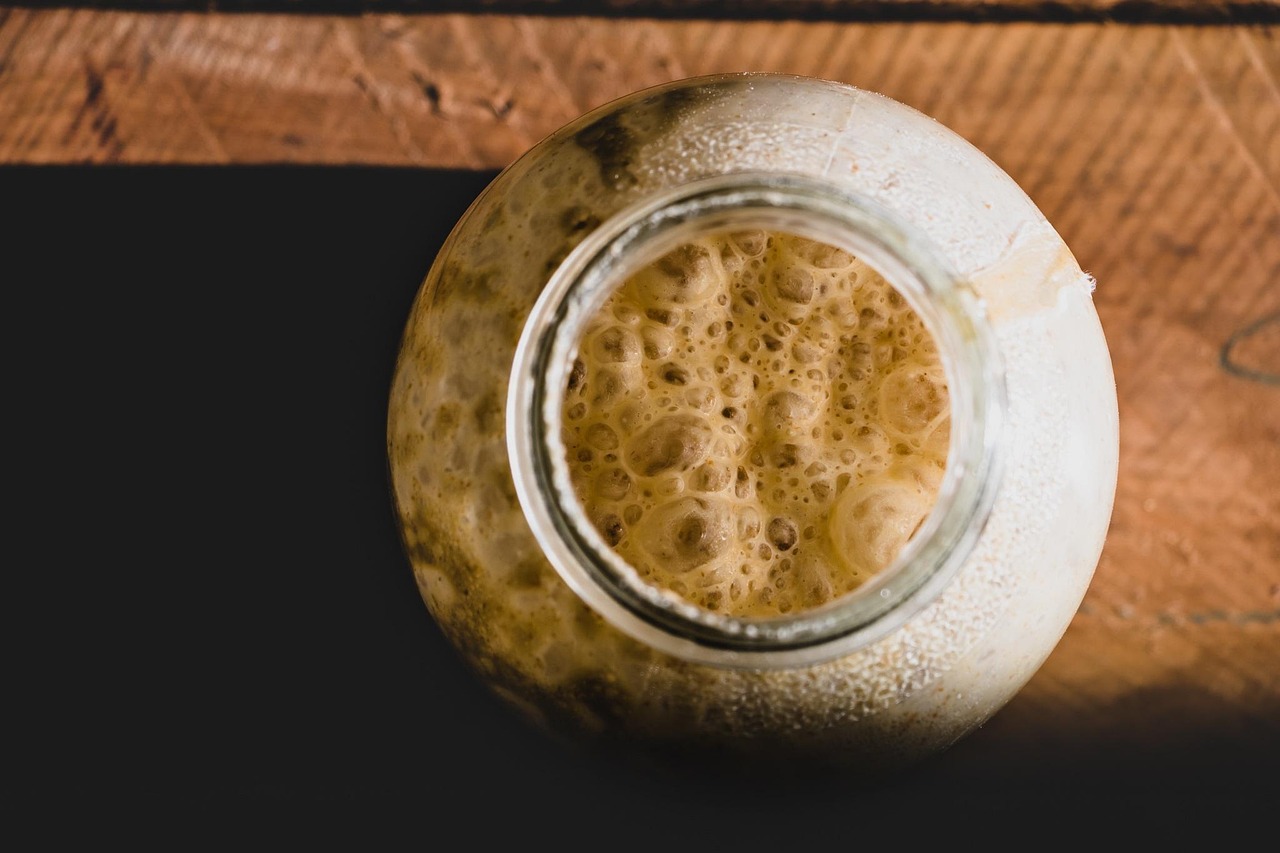
An active starter reliably doubles within 4 to 8 hours of a feed, at a steady 75°F, and does it two or three days in a row. It is full of bubbles all the way through, domed on top, and smells pleasantly sour, like yogurt or beer. That is when it is ready to bake with. Use it at or close to its peak, when it has about doubled and before it starts to fall.
The float test, dropping a spoonful into water to see if it floats, is often recommended but is not reliable: rye and whole wheat starters can sink and still raise bread well. The rubber band on the jar is a better test. A starter that doubles is ready.
Most of the problems on the way there are a matter of temperature. Below about 68°F everything slows down a lot. Put the jar in the oven with only the light on, with a note taped to the door so nobody heats the oven, or on top of the fridge, and check it is not getting much over 80°F.
Day 3: the false start
Nearly every new starter does the same thing. On day 2 or 3 it suddenly bubbles up and may double, then a day later it goes flat and smells odd, like cheese, nail polish or old socks. The early burst comes from bacteria that thrive before the mixture is acidic; as the acid builds, they die off and the true sourdough yeasts and bacteria take over. It is a common reason people throw out a starter that was working. Keep feeding on schedule, and in a few days it comes back to life.
Keeping a starter in the fridge
If you bake once a week or less, keep the starter in the fridge and feed it once a week. Feed it, leave it at room temperature for 1 to 2 hours so the yeast gets going, then refrigerate it with the lid on. A well-established starter can survive several weeks of neglect in the fridge, though it will need a few feeds to recover.
To feed a sourdough starter from the fridge for baking, take it out the day before. Discard all but 50 g and feed it at 1:1:1, then feed it again 12 hours later. By the next morning it should be at full strength. If it is slow, give it a third feed.
Is it moldy, or just old?
Hooch, the gray liquid on top, is harmless. So is a dry, darker crust on the surface of a starter that has been left uncovered. A starter can also smell strongly of vinegar or acetone when it is hungry, and that goes away after a feed or two.
Mold is different, and a moldy sourdough starter should be thrown out. Fuzzy spots of any color (white, green, blue or black) are mold. So are pink or orange streaks or a pinkish tinge to the starter, which come from bacteria. Do not scrape the top off and keep the rest: mold grows roots through the starter that you cannot see. Throw it away, wash the jar in hot soapy water and start again. Mold is much more likely in the first few days, before the starter is acidic enough to protect itself, so keep the sides of the jar clean and the lid loose but on.
Sourdough discard
The starter you pour off at each feed is sourdough discard. Throw away the discard from the first week: until the starter is established and rising reliably, it is not yet a stable culture. After that, it can go straight into the trash, or into a jar in the fridge, where it keeps for about a week and can be used in recipes that do not rely on it to rise.
- Sourdough discard pancakes. Whisk 1 cup (240 g) of discard with 1 egg, 1 tbsp sugar, 2 tbsp melted butter, 1/4 tsp salt and 1/2 tsp baking soda, which reacts with the acid in the discard and makes them rise. Cook on a hot, lightly oiled griddle. They are tangy and very tender.
- Crackers and flatbreads. Discard mixed with a little flour, olive oil and salt, rolled thin and baked, makes crisp crackers.
- To cut down on discard, keep a smaller starter. A no-discard starter keeps 10 to 20 g in the jar and builds it up only the day before baking, by feeding it at 1:5:5.
Sourdough pizza dough
An active starter makes pizza dough with a crisp, blistered crust and more flavor than yeast dough. For 3 medium pizzas, mix 100 g of active starter, 500 g of bread flour, 325 g of water, 10 g of salt and 1 tbsp of olive oil. Leave it at room temperature for 4 to 6 hours, folding it once or twice in the first two hours, then divide it into 3 balls and refrigerate them, covered, for 1 to 3 days. Bring them back to room temperature for 2 hours before shaping. The long cold rest is where most of the flavor develops.
Dehydrated sourdough starter
Drying some starter is insurance in case the jar is ever lost. Spread a thin layer of active starter on parchment and leave it at room temperature for 1 to 3 days, until it is completely dry and brittle. Crumble it and keep it in a sealed jar in a cool, dark place, where it lasts for many months. To revive it, stir 20 g of the flakes with 20 g of warm water, leave it 1 hour, then feed it as on day 2 of the recipe. It is usually active again within 3 to 5 days.
Other kinds of starter
- Gluten-free sourdough starter. Brown rice flour makes a reliable gluten-free starter, made exactly the same way. It ferments quickly and is ready in about a week. Sorghum and buckwheat flours work too.
- Rye sourdough starter. Feed it on whole rye flour alone, at a slightly higher hydration, about 110 percent. It is the traditional starter for German and Scandinavian rye breads.
- Potato flake starter. Recipes for a starter made with instant potato flakes, sugar and water are often called sourdough starters, but most begin with a packet of commercial yeast. They make a soft, sweet bread, not a sourdough.
What it is worth nutritionally
A starter is not eaten on its own, so there is no nutrition per serving. What it does is change the bread. Long fermentation breaks down much of the phytic acid in whole grain flour, which otherwise binds iron and zinc; our article on iron-rich foods explains why that matters. Some studies have also found a slightly smaller rise in blood sugar after sourdough than after yeast bread made from the same flour, though the results vary. For a bread that needs no starter, try our banana bread.