Vitamin B12 foods and supplements: what has it, who runs short, and why it hides
B12 comes from bacteria, not plants. That one fact explains the food list, why vitamin B12 supplements exist, and why a deficiency takes years to surface.
August 12, 2026 · 7 min read

Photograph by ready made on Pexels
Vitamin B12 is made by microorganisms. Not by plants, which have no mechanism to synthesize it and no use for it, and not by animals — animals accumulate what their gut bacteria produce or what they eat. Every reliable natural source of B12 in the human diet is therefore an animal food, and that single fact explains everything else in this article: the shape of the food list, the existence of an enormous vitamin B12 supplement market, and why the deficiency is so good at hiding.
The requirement itself is tiny. Adults need around 2.4 micrograms a day, rising slightly in pregnancy and lactation. Anyone eating animal products with any regularity clears that without thinking about it. The interesting question is not how much is in the food — it is how much of it you actually absorb, because B12 is unusual in that respect.
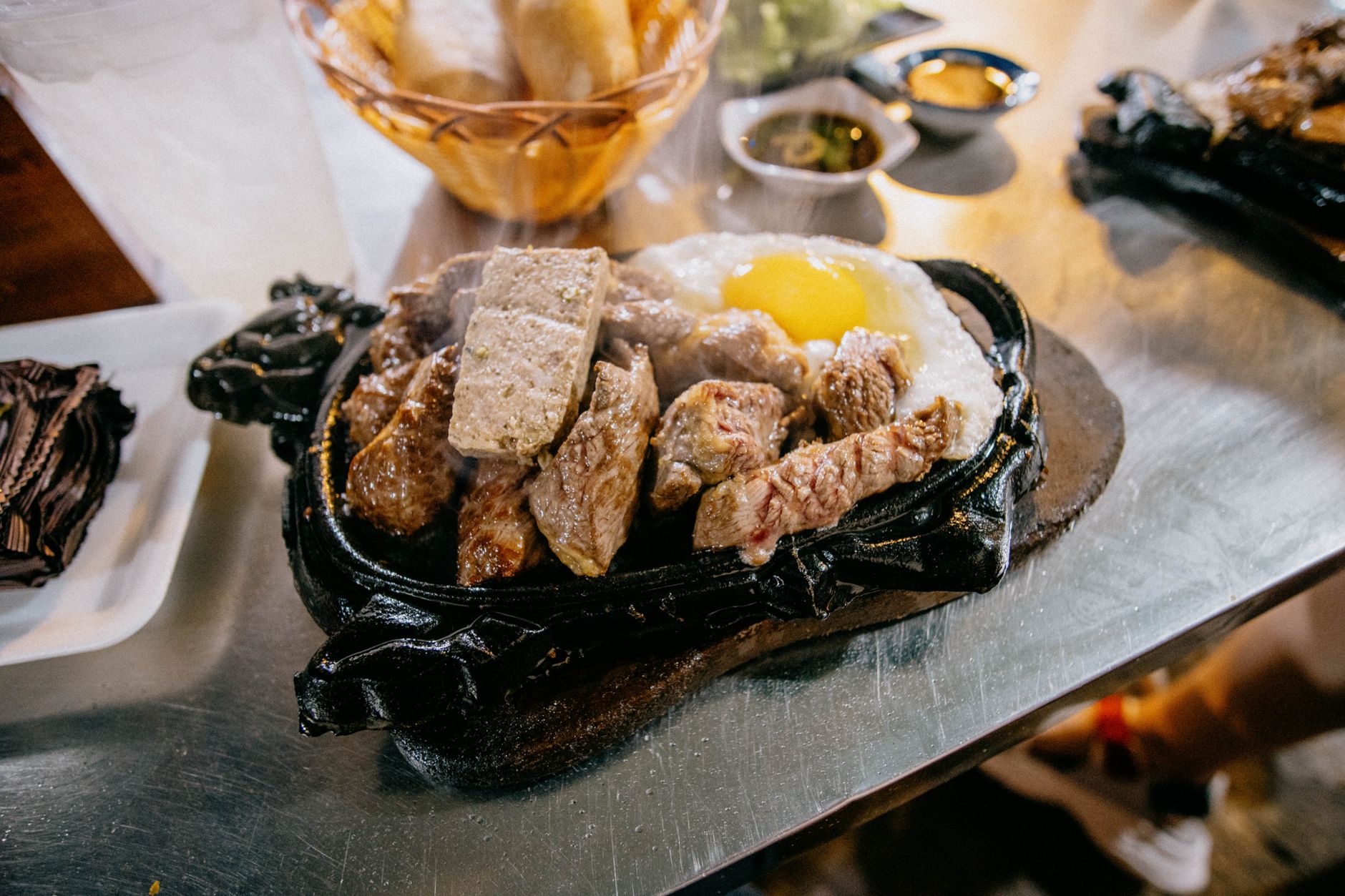
Foods high in B12, by density
Ordered by how much they contribute per realistic serving rather than per 100 grams, which flatters foods nobody eats in quantity.
- Liver and kidney. Extraordinary amounts — a single serving of beef liver contains many times the daily requirement. This is the densest source of B12 in the human diet by a wide margin.
- Clams, mussels and oysters. The richest non-organ source. A small portion of clams rivals liver.
- Oily fish. Sardines, mackerel, salmon, herring, trout. Several micrograms per fillet, and they bring long-chain omega-3s with them.
- Beef, lamb and pork. Solid contributors, a few micrograms per serving.
- Eggs and dairy. Smaller amounts, but the B12 in milk is absorbed unusually well — better, proportionally, than the B12 in meat.
- Fortified foods. Nutritional yeast, plant milks, some breakfast cereals and meat analogs. Fortification is not standard, so the label is the only way to know.
What is not a source, despite the claims
This list matters as much as the one above, because the foods on it are actively promoted as plant B12 sources. Spirulina, chlorella, tempeh, unfortified nutritional yeast and most sea vegetables contain B12 analogs — pseudovitamin B12 — which are structurally similar enough to register on some blood assays while doing nothing biologically in humans.
The consequence is worse than simply having no B12. An analog can produce a reassuring test result on top of a genuine deficiency, and there is some evidence that analogs compete with real B12 for absorption. Anyone relying on these foods on a vegan diet should treat them as containing none.
Why absorption, not intake, is the real story
B12 has the most elaborate absorption pathway of any vitamin. It is bound to protein in food and has to be released by stomach acid and pepsin. It then binds to haptocorrin in saliva, is transferred to intrinsic factor — a protein made by the stomach's parietal cells — and the intrinsic-factor complex is finally absorbed at a specific receptor in the terminal ileum.
That pathway saturates at roughly 1.5 to 2 micrograms per dose. Eating an enormous amount at one sitting does not help proportionally; the excess passes through. This is also why supplements are dosed at 25, 100 or 1,000 micrograms rather than at the 2.4 microgram requirement: at high doses a small percentage — around 1% — crosses the intestinal wall by passive diffusion, bypassing intrinsic factor entirely. A 1,000 microgram tablet delivering 1% still delivers 10 micrograms, comfortably above the requirement.
The clinically important implication: anything that damages the stomach or the terminal ileum produces deficiency on a perfectly adequate diet. Diet is only one of several ways to run short.

Who actually runs short of vitamin B12
Vegans and long-term vegetarians
The obvious group. Vegans have no dietary source at all without fortification or supplementation. Vegetarians eating dairy and eggs are better placed but not safe — intakes are frequently marginal, and deficiency in long-term lacto-ovo vegetarians is well documented.
Adults over about 50
Stomach acid production declines with age, and food-bound B12 needs acid to be released from its protein. Crystalline B12 in fortified foods and supplements does not. This is why several national guidelines specifically advise older adults to get some of their B12 from fortified food or a supplement rather than from meat alone — the food is fine, the stomach is the constraint.
People on metformin
Metformin measurably lowers B12 over years of use, through an effect on calcium-dependent absorption in the ileum. Given how many people take metformin long-term for type 2 diabetes, this is one of the largest at-risk groups and one of the least discussed.
People on long-term acid suppression
Proton pump inhibitors and H2 blockers reduce the acid needed to liberate food-bound B12. The effect is modest over months and meaningful over years.
After gastric or intestinal surgery
Bariatric surgery removes or bypasses the stomach tissue that makes intrinsic factor. Ileal resection removes the absorption site. Celiac disease and Crohn's disease damage it. In all of these, oral B12 may not be enough.
Pernicious anemia
An autoimmune condition destroying the parietal cells that produce intrinsic factor. It is the classic cause of severe B12 deficiency and it does not respond reliably to ordinary oral doses — it is treated with injections or very high-dose oral therapy under medical supervision.
Vitamin B12 deficiency symptoms, and why they arrive late
The liver stores between two and five years of B12. So the intake can stop entirely and nothing happens for a very long time. When symptoms do arrive they tend to arrive together:
- Fatigue and breathlessness, from megaloblastic anemia.
- Pins and needles, numbness, or a burning sensation in hands and feet.
- A smooth, sore, red tongue — glossitis.
- Unsteadiness, particularly in the dark, when vision can no longer compensate for damaged position sense.
- Memory problems, irritability and low mood.
The dangerous interaction is with folate. High folate intake — from a diet rich in leafy greens and legumes, or from fortified flour — corrects the anemia that would otherwise be the first visible warning, while the neurological damage continues underneath. That is why a clinician investigating this measures B12 directly rather than reading it off a full blood count, and why the standard advice is to test rather than to guess.
Long-standing nerve damage may not fully reverse even after treatment. That is the whole argument for testing early rather than waiting to feel worse.

Choosing a vitamin B12 supplement
Cyanocobalamin is the cheapest, most stable and most studied form, and it is what the large trials used. Methylcobalamin is marketed as more "natural" or better absorbed; the evidence for a meaningful advantage in healthy people is weak. For most people the cheaper form is the correct choice, and the money saved is better spent on actually taking it consistently.
Typical regimens are 25 to 100 micrograms daily, or 1,000 to 2,000 micrograms once or twice weekly — the higher weekly dose works because of the passive diffusion route described above. Sublingual tablets have no demonstrated advantage over swallowed ones for people with normal absorption.
B12 is water-soluble and has no established upper limit; excess is excreted. Toxicity is not the concern. Complacency is.
The practical version
If you eat animal products regularly, are under 50, take no metformin or acid suppression, and have no gut condition, you almost certainly do not need to think about this at all. That describes most people.
If you fall into any of the groups above, this is worth an actual blood test rather than an assumption — and if it comes back low, the fix is cheap, effective, and much easier than living with the consequences of leaving it. Ask specifically about B12 rather than accepting a normal blood count as reassurance.