Greek salad
Traditional Greek salad, or horiatiki: ripe tomatoes, cucumber, pepper, red onion and olives under a slab of feta, dressed with olive oil and oregano. No lettuce, as in Greece.
- 340
- kcal
- 9g
- protein
- 28g
- fat
- 14g
- carbs
- Prep
- 15 min
- Serves
- 4
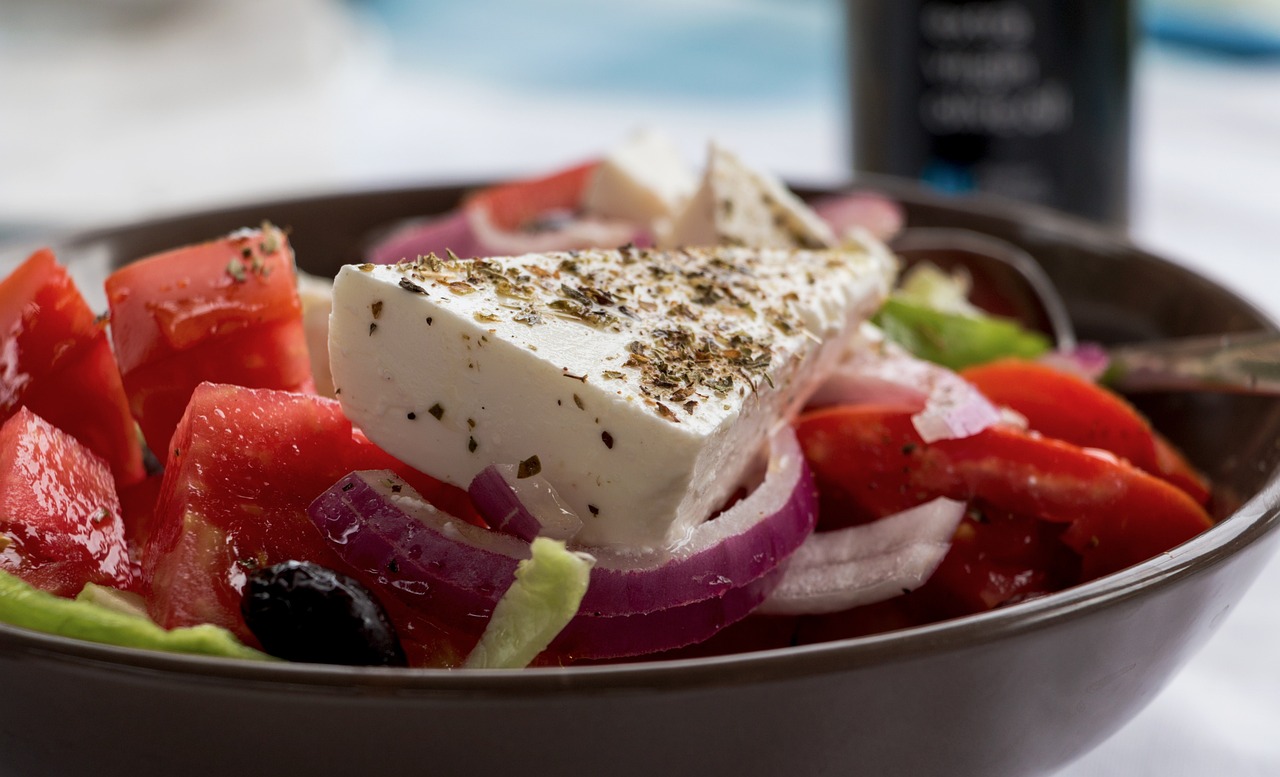
Photograph by lukasbieri on Pixabay
Ingredients
- 4 ripe medium tomatoes (about 1 1/4 lb)
- 1 cucumber, peeled in stripes
- 1 green bell pepper
- 1/2 red onion
- 1/2 cup (70 g) Kalamata olives
- 7 oz (200 g) block of Greek feta
- 1/4 cup extra-virgin olive oil
- 1 tbsp red wine vinegar
- 1 tsp dried oregano, preferably Greek
- 1 tbsp capers, rinsed (optional)
- Flaky salt and black pepper
Method
-
1
Cut the vegetables
Cut the tomatoes into wedges and then into large chunks. Halve the cucumber lengthwise and cut it into thick half-moons. Slice the pepper into thin rings and the onion into thin slivers.
-
2
Salt the tomatoes
Put the tomatoes and cucumber in a wide bowl and sprinkle with a little salt. Leave 5 minutes, so they release some juice to mix with the oil.
-
3
Add the rest
Add the pepper, onion, olives and capers, drizzle with the vinegar and half the oil, and toss gently.
-
4
Top with the feta
Lay the feta on top in one piece or a few thick slices. Sprinkle the oregano and some black pepper over it and pour the rest of the oil over everything.
-
5
Serve
Serve at once, with bread to mop up the juices at the bottom of the bowl.
What makes a Greek salad Greek
In Greece, this is horiatiki, "village salad", and it has no lettuce. It is chunks of tomato, cucumber, green pepper and onion, a handful of olives and a thick slab of feta on top, dressed with olive oil and a pinch of oregano, and eaten with bread to soak up the juices. The version served in many American restaurants, on a bed of romaine with a bottled dressing, is a different salad. Both are good, but this is the original.
It is only as good as the tomatoes
A Greek salad has nothing to hide behind. It is at its best in summer with ripe, juicy tomatoes. The rest of the year, use cherry or grape tomatoes, which are more reliable than large supermarket tomatoes, and halve them. Do not refrigerate tomatoes that are not fully ripe: cold stops them ripening and turns them mealy.
Salting the tomatoes and cucumber for a few minutes before dressing them draws out some of their juice. That juice, mixed with the olive oil and oregano, is the best part of the salad, so have bread on the table, and a bowl of tzatziki if you are serving it with grilled meat.
Buying feta
Buy feta in a block, packed in brine, and not crumbled. Crumbled feta is dry, and is often coated with an anti-caking agent. Under EU rules, only cheese made in Greece from sheep's milk, or sheep's milk with up to 30% goat's milk, can be called feta there. American feta is often made from cow's milk. It is fine, but firmer and less tangy. Look for "Greek" or "sheep's milk" on the label for the real thing.
Greek salad dressing
The traditional salad needs no separate dressing: just oil and a little vinegar, straight onto the vegetables. For a dressing to keep in the fridge, closer to the American restaurant style, shake together:
- 1/3 cup extra-virgin olive oil
- 3 tbsp red wine vinegar
- 1 tbsp lemon juice
- 1 small clove garlic, finely grated
- 1/2 tsp Dijon mustard
- 1 tsp dried oregano, and salt and pepper to taste
It keeps a week in the fridge. The olive oil goes solid when cold, so take it out 20 minutes before using it, and shake it again.
Greek pasta salad
The same salad turns into a Greek pasta salad with 8 oz (225 g) of dry short pasta, such as rotini, penne or farfalle. That is about half a standard box, and it makes 6 side servings.
- Cook the pasta in well-salted water for a minute longer than the package says for al dente. Pasta firms up as it cools, and pasta that was just al dente when hot is chewy in a cold salad.
- Cool it fast. Drain it, rinse it briefly under cold water, and shake it dry. For a hot dish you would never rinse pasta, but for a cold salad it stops the cooking and keeps the pieces from sticking together.
- Cut everything smaller, about the size of the pasta, so you get some of everything in each forkful. Crumble the feta instead of leaving it in a slab, and halve the olives.
- Use more dressing. Pasta soaks up oil and vinegar, and the 1/4 cup of oil and 1 tbsp of vinegar in the salad are not enough. Use the whole batch of the Greek salad dressing above instead. Toss the pasta with about half of it first, before the vegetables go in, so it seasons the pasta itself.
Made this way, a side serving (one sixth) has about 395 kcal, with 11 g of protein, 22 g of fat and 38 g of carbohydrate. It keeps 3 days in the fridge, because the pasta holds up better than the plain salad does. The pasta drinks up the dressing overnight, so add a splash of vinegar and a little oil before serving.
Variations
- As a meal: add grilled chicken, shrimp or a can of drained chickpeas, which takes it most of the way to our Mediterranean chickpea salad.
- With lettuce: toss the salad with a chopped head of romaine and the dressing above, and crumble the feta over it.
- With dakos: the Cretan version is served over barley rusks that soften in the juices.
What it is worth nutritionally
A serving has about 340 kcal, with 9 g of protein, 28 g of fat and 14 g of carbohydrate, including about 3 g of fiber. Most of the fat is from the olive oil, which is mostly monounsaturated, and the rest from the feta and olives. Use less oil for a lighter salad: each tablespoon left out saves about 30 kcal a serving. Feta and olives are both salty, so add very little salt. The salad is a good source of calcium, from the feta, and of vitamin C. It is central to the Mediterranean diet, and it is vegetarian and gluten-free. Traditional Greek feta is often made with animal rennet, so for a strictly vegetarian salad choose one labeled vegetarian.